


Medical education M&A activity remains robust
The U.S. medical education market is on pace to reach $61.4 billion by 2028, with private equity driving 68% of sector transactions as acquirers race to build scaled, technology-driven platforms across the healthcare professional learning lifecycle.

The medical education sector is experiencing robust growth, fueled by healthcare industry expansion, mandatory continuing education requirements, and the accelerating digitization of clinical training. Mergers and acquisitions remain highly active, with strong interest from both strategic and financial buyers pursuing assets that can address the full lifecycle of a healthcare professional’s education — from pre-licensure through continuous career development.
The U.S. medical education market was valued at approximately $39.2 billion in 2023 and is projected to reach $61.4 billion by 2028, growing at a 9.4% compound annual growth rate. The continuing medical education (CME) submarket alone is forecast to expand from $3.35 billion in 2024 to $4.67 billion by 2030. These figures reflect a sector with durable demand drivers, recurring revenue characteristics, and long-term tailwinds tied to healthcare workforce expansion and regulatory complexity.
In this sector update, we examine the forces shaping M&A activity in medical education — from the 34 deals recorded since June 2024 and private equity’s 68% share of transaction volume, to the rise of simulation-based learning, AI-integrated curricula, and the platform roll-up strategies reshaping the competitive landscape.
Medical education sector at a glance
The U.S. medical education sector encompasses the training and development of healthcare professionals through medical schools, continuing medical education (CME) programs, online learning platforms, and simulation-based training. The sector plays a critical role in addressing demand for skilled healthcare workers amid an aging population and rapidly evolving medical technologies. It is characterized by resilient, non-cyclical demand; recurring revenue models tied to licensure maintenance; and strong technology adoption tailwinds.
Broader healthcare education estimates place the global market at approximately $118 billion in 2024, projected to reach $268 billion by 2034 (8.5% CAGR). North America dominates the global market with approximately 36.5% share, led by the United States’ advanced infrastructure and high investment in education technology. While major hubs remain concentrated in California, New York, and Massachusetts, online and digital platforms have extended sector reach nationwide and globally, enabling access for rural and international learners.
Key segments
The sector can be segmented into five categories, each with distinct growth drivers: continuing medical education (CME), driven by mandatory credit requirements covering new clinical guidelines, drug therapies, and surgical techniques; exam preparation & licensing, designed to help students and professionals pass critical exams such as USMLE, MCAT, and NCLEX; simulation-based learning, the fastest-growing segment, using high-fidelity manikins, VR and AR to train clinical skills in risk-free environments; online learning & digital platforms, including e-learning modules, mobile apps, and learning management systems that offer flexibility and scalability; and graduate programs, residency and fellowship support, including interview preparation, application consulting, and placement services for medical graduates seeking specialized training positions.
M&A trends & drivers
M&A activity in medical education remains robust and is characterized by strong competition for high-quality assets. The market has transitioned from post-pandemic normalization in 2023 to a renewed surge through 2024 and into 2025, driven by pent-up demand from strategic buyers and significant dry powder held by private equity sponsors. The prevailing strategy is “platform-and-add-on,” where a financial or strategic buyer acquires a large platform company and subsequently bolsters it with smaller, synergistic tuck-in acquisitions to expand product offerings, geographic reach, or customer segments.
Over the last twelve months, the medical education M&A market has remained steady, with 34 deals recorded since June 2024. The sector saw a significant spike in investment activity during Q2 2025, with 14 total deals — 10 of which came from private equity investors. With the number of physicians and healthcare workers projected to grow over the next several years, transaction volume is expected to remain elevated. Strategic buyers accounted for 32% of 2025 YTD transactions (11 deals), while financial buyers accounted for 68%, a notable shift toward sponsor-led consolidation.
Key drivers of M&A activity
The high level of M&A activity is not a transient phenomenon but is driven by fundamental, structural factors: a fragmented market opportunity, with hundreds of small privately-owned providers specializing in niche areas and ripe for consolidation; recurring revenue and defensive characteristics, with CME and licensing exam prep largely immune to economic cycles because healthcare professionals must maintain credentials regardless of macro conditions; the digital transformation imperative, as acquirers seek proprietary technology, SaaS platforms, and innovative learning tools that are faster to acquire than to build; the strategic need for comprehensive solutions, as acquirers build one-stop-shops across the learner lifecycle from textbook through simulation to test readiness; and favorable demographic and regulatory tailwinds, with an aging population increasing healthcare service demand while licensing bodies continually expand credential requirements.
Emerging trends reshaping medical education
Medical education is undergoing significant transformation driven by technological advancements, evolving healthcare needs, a focus on personalized learning, and a renewed emphasis on clinician well-being and career longevity. Several emerging trends are reshaping the competitive landscape and influencing both organic growth strategies and M&A investment theses across the sector.
AI integration into core curricula
Medical schools are increasingly embedding AI education directly into their programs, moving beyond concerns about its disruptive potential to actively teaching its applications. This includes introductory courses on AI tools, ethics, and prompt engineering, as well as hands-on training in using AI for diagnostics, treatment planning, and research. By 2025, surveys indicate that over 77% of U.S. and Canadian medical schools already cover AI in their curricula, with expectations for this to become universal to ensure graduates can responsibly integrate AI into patient care.
Competency-based education, ethics, and physician well-being
Competency-based education (CBE) shifts from time-based progression — four years of medical school, three years of residency — to mastery of specific skills and competencies, allowing students to progress at their own pace with a focus on practical application and real-world clinical scenarios. CBE is gaining traction for its flexibility and alignment with modern healthcare demands. At the same time, as AI becomes integral, education is emphasizing ethical use, bias mitigation, and human judgment to avoid over-reliance that could erode critical thinking or empathy. The sector is also seeing a systemic shift from reactive burnout treatment to proactive training in mindfulness, stress management, and finding meaning in work — aimed at creating a more sustainable training environment that produces healthier, more resilient physicians.
Workforce shortage tailwinds
Many of these trends are emerging in response to expected workforce shortages. The Association of American Medical Colleges (AAMC) projects a shortage of 86,000 physicians by 2036, driven by high burnout rates, an aging population, and lack of residency spots. According to the U.S. Health Resources and Services Administration, an estimated 19,000 physicians are needed to overcome current shortages. A recent AMA survey of 18,000 physicians found that 32% reported interest in leaving their current jobs within the next two years — a slight improvement from 36% in 2023, but still a persistent retention challenge that compounds the workforce pipeline opportunity for sector acquirers.
Notable transactions
Four representative transactions from the past year illustrate the major themes driving sector consolidation: CME content acquisitions in specialized therapeutic areas, radiology education consolidation through platform roll-ups, simulation and VR as a strategic priority, and exam prep expansion through complementary content acquisitions.
In January 2025, TrueLearn — a digital learning and analytics firm focused on healthcare — acquired Medality, a leading platform for radiology education and practice development. Medality provides clinical readiness tools, microlearning libraries, and practice expansion resources to assist radiologists at all stages of their careers.
The integration of Medality’s platform into TrueLearn’s ecosystem strengthens TrueLearn’s position in specialty medical education, particularly in radiology. The combination aims to boost learning outcomes, enhance clinical practice, and support diagnostic accuracy across healthcare systems — a strategic fit that reflects broader sector appetite for specialty-depth content platforms.
In March 2025, The Lockwood Group — a scientific communications company serving life sciences clients and backed by Ares Management since October 2021 — acquired IDEOlogy Health, a leading provider of oncology-focused continuing medical education. IDEOlogy is known for expert-led roundtables, post-congress insights, and thought leadership programs tailored to oncologists across the U.S.
The acquisition strengthens Lockwood’s leadership position in the oncology education space and advances its broader expansion plan across specialty therapeutic areas. The deal reflects private equity’s continued enthusiasm for CME platforms with defensible specialty positioning and recurring life sciences client relationships.
In January 2025, Archer Review — a Leeds Equity Partners portfolio company — acquired OnlineMedEd, used by more than 300,000 learners in 190+ countries. OnlineMedEd was founded to elevate medical education through a comprehensive, longitudinal curriculum that emphasizes deep learning and clinical reasoning over memorization.
Combining OnlineMedEd’s rich medical content with Archer Review’s adaptive learning technology positions the combined entity to become a leading medical and nursing education company. The transaction exemplifies the “platform-and-add-on” strategy that has come to define the sector, with financial sponsors building comprehensive learner lifecycle coverage through successive acquisitions.
In June 2025, HealthpointCapital — a leading private equity firm focused exclusively on musculoskeletal healthcare — acquired ImmersiveTouch, a patented proprietary VR and AR software platform used for surgical planning and training. The founder noted that the partnership with HealthpointCapital will accelerate the company’s commercialization and product development efforts.
The transaction reflects the expanding role of simulation and immersive technology in clinical training, with specialist private equity firms now pursuing VR/AR medical assets. Combined with Madison Industries’ October 2024 acquisition of SimX, the deal signals that simulation-based learning is becoming a category where strategic capital is actively building scaled platforms.
Buyer universe
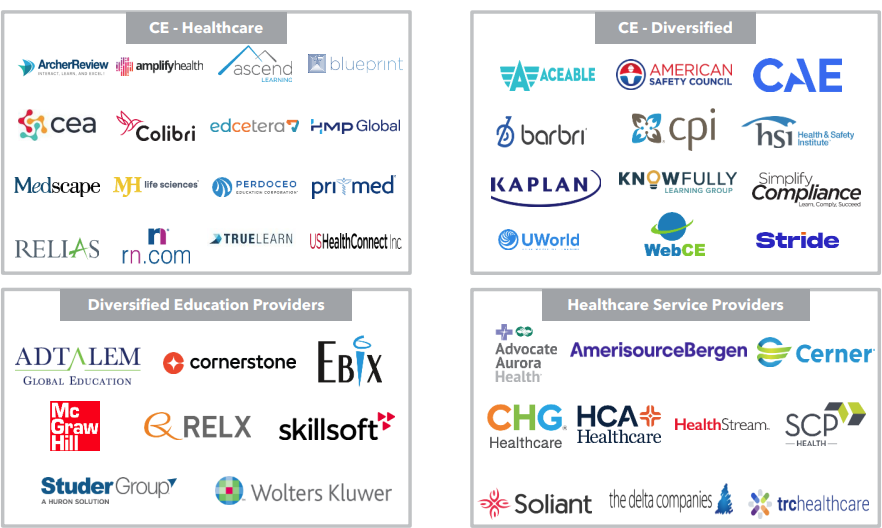
Navagant has long-standing relationships with many of these firms through recent transactions in the medical education sector. We have also tracked buyers that have been highly acquisitive across continuing medical education, exam preparation, simulation-based learning, and digital healthcare learning platforms. Our sector expertise and network provide us with unique insights into the buyer universe and growth drivers of the companies within it.

Navagant case studies
Representative transactions from Navagant’s medical education practice, showcasing our expertise across continuing medical education and high-stakes healthcare exam preparation.
Neuroscience Education Institute

Background
Neuroscience Education Institute (“NEI Global”) is a leading provider of behavioral health education, helping physicians, nurse practitioners, physician assistants, and other clinicians meet continuing medical education (“CME”) requirements and professional education goals.
Process Highlights & Outcome
NEI Global selected Navagant as its investment banking advisor based on our track record in the continuing medical education sector. We ran a broad process with both strategic buyers and financial sponsors, yielding numerous competitive proposals.
HMP Global emerged as NEI’s preferred transaction partner. The combined entity holds unparalleled reach and content development capabilities in the CNS-focused psychopharmacology space, with potential to dramatically improve continuing education for mental health clinicians and contribute to better patient outcomes. The transaction was recognized as the 2023 USA M&A Deal of the Year.
Rosh Review

Background
Rosh Review is an industry-leading provider of online professional training for nurse practitioners, physicians, and physician assistants. The company specializes in high-stakes board exam prep and continuing medical education and has served more than 228,000 learners and 740 institutions to meet their medical education needs.
Process Highlights & Outcome
Rosh Review ran a broad investment banking advisor selection process, interviewing 12 different banks before choosing our team based on industry expertise, a team-based approach, and cultural fit. We ran a broad process with both strategic buyers and financial sponsors, yielding numerous competitive proposals.
Blueprint Test Prep — a former client of Navagant’s — emerged as Rosh’s preferred transaction partner. Acquiring Rosh Review grants Blueprint access to proven teaching methodologies, course materials, online learning platforms, and data-driven analytics across the medical spectrum. The transaction was recognized as the 2022 Education Services Deal of the Year.
Meet the team behind this report

With over two decades of experience, Jacob is the Managing Director of Navagant, having been a key contributor since its inception. Leading as Managing Director and Co-Founder, he has played a vital role in establishing Navagant’s strong brand presence. He began his career at Rabobank International and later focused on software and direct marketing industries with Andersen Corporate Finance LLC. In 2003 he founded Capstone Partners and led their Education and Training Practice, until 2023 when he co-founded Navagant.

Shawn is a Founding Member and Managing Director of Navagant and brings over 18 years of experience to the firm. Shawn has led execution efforts on 70+ transactions resulting in over $3.5 billion of proceeds for clients. Formerly, he served as a Managing Director of Capstone Partners in the Education and Training practice. Shawn’s previous experience includes serving as an officer in the US Navy where he served as a destroyer navigator and communications officer, student naval aviator, and fleet Tomahawk cruise missile officer.

Sachin is a Vice President at Navagant. Prior to Navagant, he was an Associate in Capstone Partners’ Education and Training practice and an Analyst at DC Advisory in the industrials group, focused on sell-side and buy-side M&A advisory. He also interned at Sagent Advisors in Chicago, IL.
Endnotes & sources
- MarketsandMarkets. US Healthcare Education Market Worth US$61.44 Billion by 2028 with 9.4% CAGR. PR Newswire, March 28, 2025.
- MarketsandMarkets. U.S. Continuing Medical Education (CME) Market Outlook 2025–2030.
- Boyle, Patrick. Medical schools move from worrying about AI to teaching it. AAMC News, May 15, 2025.
- Medical Center of Southeastern Oklahoma. The Future of Medical Education: Emerging Trends and Challenges.
- Association of American Medical Colleges. New AAMC Report Shows Continuing Projected Physician Shortage. AAMC News, March 21, 2024.
- Mukkamala, Bobby, M.D. The Physician Shortage Will Worsen — Unless Congress Acts Now. American Medical Association, June 16, 2025.
- Berg, Sara, M.S. Physicians in These 10 Specialties Are Less Likely to Quit. American Medical Association, June 24, 2025.
- PR Newswire. The Lockwood Group Welcomes IDEOlogy Health — Accelerating Its Leadership Role in Community Oncology. June 26, 2025.
- BusinessWire. TrueLearn Acquires Medality, a Leading Education and Practice Development Platform for Radiologists. February 19, 2025.
- Leeds Equity Partners. Leeds Equity Partners Forms Healthcare Education and Licensure Platform with the Acquisition of Archer Review. PR Newswire, October 28, 2024.
- Business Wire. Archer Review, a Leeds Equity Portfolio Company, Acquires OnlineMedEd, Expanding its Reach in Medical Education. March 19, 2025.
- Madison Industries. Virtual Reality Medical Simulation Pioneer SimX Joins Madison Industries. June 20, 2024.
- HealthpointCapital. HealthpointCapital Acquires ImmersiveTouch, Inc., a Leading Extended Reality Surgical Platform. PR Newswire, June 30, 2025.
- PitchBook transaction data, accessed September 2025.